Friday, July 17, 2020

Reverse Migration

"Epidemics are not random events that can afflict societies capriciously and without warning" 
says historian Frank Snowden in his book Epidemics and Society. On the contrary, every society produces its own specific vulnerabilities.
The critical vulnerabilities of Indian society, that the Covid-19 has exposed is one of the worst humanitarian crisis the country has ever faced since independence, started with the 4- hour notice for a complete shutdown of the economy. The appalling details of the suffering by masses of the uprooted people lacking access to shelter, food or sources of income or even means of transport to take them back to their native places, depict the subhuman condition for a vast majority of the working class in the country at this hour. The shearing images of the endless ordeal of thousands of famished and exhausted “migrant workers” trying to make their way back to their home to escape starvation in cities will endure long even after the pandemic is over. Lockdown has dealt a body blow to their insecure and fragile urban livelihoods and many of them also faced imminent eviction. With public transportation not in force many began their long journeys on foot over distances that could span hundreds of miles. A large number of them died of heat, exhaustion and starvation; and quite a few were killed in horrific accidents. 

Why People Migrate?
 
Migrant workers are a part of the informal workforce which is 93% of aggregate labour force having hardly an access to the benefits in the formal organised sectors. Barring abnormal times, which includes current circumstances, the major part of the migrant labour flows in India has mostly been from rural to urban areas. Interstate migration for better employment, better wages and better standard of living has been an integral part of the humdrum existence of millions of landless and asset less poor for generations. As described by P Sianath migrants include the categories of people who migrate on permanent basis(having no plan to return); seasonal migrants (who temporarily return from urban to rural during the harvest and then go back to urban centres) and finally the footloose (hired from rural areas by contractors) who move from city to city in search of their livelihood. This usual pattern of migration, which pushes people from rural to urban areas can be described as ‘mobility by default. According to Harris-Todaro, migration proceeds in response to rural-urban differences in expected income rather than actual earnings and they tend to migrate if expected urban wage is greater that the actual rural wage including the cost of migration.
The reasons behind this include growing rural distress with agriculture and inadequate official policies to support the ailing rural poverty. Migration has also been facilitated by the prevailing familial links.

What is reverse migration & why is reverse migration taking place?
 
Migration from rural to urban areas is a key in any country’s development. But a shock such as Covid-19 puts the migrants in a vulnerable situation in which reverse migration might seem to be the least coping mechanism available to them. The current flow of reverse migration (a situation when labourers, workers, and people start migrating back to their native place in the backdrop of non-availability of livelihood and job opportunities) in India, which is from urban to rural doesn’t fall into the usual pattern of migration. Miles away from their villages the migrants were facing extreme financial crunch as the pandemic has rendered them jobless and the only path that was open to them was to return home. So, when thousands of migrants rushed to catch trains it led to chaos and confusion and opened up several issues. There is no doubt that the sheer size of this movement of workforce will have an immense impact on the urban economies and will lead to an increase in poverty, inequity and discrimination. Akhand Kumar,32, has been on a foot march from Ludhiana in Punjab to Allahabad in Uttar Pradesh for 14 days along with his wife and his kids. They have been surviving on water, biscuits and the food they got due to the kindness of others. Kumar worked at a textile factory earning Rs 10,000 per month and had been living in Ludhiana for the past 12 years. But the sudden lockdown forced him to return to his village in order to feed his family. There are thousands of migrant labourers like Kumar who have been forced to take an unprecedented journey after a lockdown was imposed. “In a recent note, Crisil estimates that India has a workforce of 46.5 crore individuals. Of this, around 41.5 crore individuals work in the informal sector of the economy, where no social benefits are available. This is why the lockdown has been so difficult for a large section of the population, said economist and author Vivek Kaul.

Are there any jobs for them in the rural sector? Will they return?

Rural India is highly dependent on the agricultural sector which is over-burdened and over populated with an underemployed working population. Its excessive reliance on agriculture and the lack diversified economic structure makes it tough to create alternative sources of income. Due to the current circumstances of nationwide lockdown thousands of migrants are returning to their villages which will lead to a sudden spike in the number if engaged in one mode of subsistence and it will be an impossible situation to provide jobs, food to millions of workers going home. It is likely that reverse migration is temporary and will return to normal once the threat of the pandemic is receded. However, it is impossible for rural India to match wage expectations of inter-state migrants and as India continues to develop there will be an increase in the job opportunities which will lead more migration from rural to urban areas.

How it can affect the economy?

Migrants workers are mainly hand-to-mouth consumer earning subsistence earning and they spend a large part of their income in the economy. This creates a separate level of demand which will likely to exit. As a consumer they are a part of an informal economy which generates and sustain volumes for the FMCG industries, which will take a blow due to reverse migration. Reverse migration may delay a part of interstate migrant workers returning to their workplace which in turn may create labour shortages and thereby further hinder an economic recovery. The lack of demand from them and the mini economies they sustain implies that forward and backward linkages to the formal sector will be weakened. Maharashtra, Delhi, Punjab are the most vulnerable states as these states attract migrant workers the most. Since sectors like transport, hospitality, construction and service sector mainly employ a higher proportion of them, they are more likely to be hit. Migrants also tend to have a high marginal propensity to consume and reverse migration will dent on consumption which will be disastrous for the economy as a whole. Meanwhile, rural distress is set to increase as the workforce which has returned to villages would put a huge burden on the already-crumbling rural economy. Reverse migration is likely to speed up the spreading of the virus as when migrants flee from the city, they not only lose jobs but also, they carry the infections to their native places which will make the situation even worse.

Way out!

These migrants are mainly a voiceless community and there is no one to raise their voice for them. Someone has to take the responsibility and it can be none better than the government. They government should bring in a road-map of how they are going to employ such a large number of migrants who have returned their homes. It is the perfect time to revamp schemes like MGNREGA and relocate the budget for them. Sectors like agriculture and industry-based agriculture should be given priority in order to provide them proper jobs. According to many this is an opportune for the government to uplift the rural economy since the workforce has returned but it would also have some consequences as well for the society. 
The people who have returned are the ones who actually run the society. There has to be a holistic approach for the migrant labourers and stress should be given on the rural economy else the economy will collapse as stated by the father of the nation Mahatma Gandhi “India does not live in its towns but in its villages”.  


Sunday, July 12, 2020

MIGRATORY DILEMMAS

As the monsoon clouds enveloped Kerala, thousands of workers from across India were migrating to their villages. Even though they had been surviving on daily wages, May is the month they would normally return to their original—and seasonal— source of livelihood: farming.

On the contrary, India’s monsoon season has begun with a deluge of woes—for workers, farmers and farming. And this is going to be the most devastating spill over of the covid-19 pandemic.
Amid the lockdown—India’s 68 days is the longest in the world—the country not only reported a consistent rise in covid-19 cases, it also willingly reconciled to live with the virus. By May 31, most of the restrictions were lifted but gave rise to another crisis of a much bigger scale.

Forced Migration

For the past few months, millions of workers were forced to return to their villages. But this was not the usual monsoon reverse migration; they were left unemployed due to the cessation of economic activities in cities and towns. It was found there were more people on the roads than in the villages.
According to the report collected by officials travelling with the migrant workers, it was seen that around 31,424 migrants between April 11 and May 20 returned to their villages. Of the 24,681 stranded adults, 37 per cent were daily-wage earners, followed by industrial labourers such as construction workers (30 per cent), farm labourers (26 per cent), and labourers employed in the service sector (7 per cent).
It is estimated that 100 million workers have moved away from
urban areas in these two months. Hence making it the largest
movement of people in India’s history. But it is also the most disruptive economic development. India’s villages were already economically weak, forcing people to migrate to towns and cities for livelihood. Now, with millions returning to the villages, an urgent expansion of the rural economy is required to sustain this transition.
To begin with, each of these workers has a family to sustain.
Together, these informal workers contribute around 10 per cent to India’s GDP. With this the agriculture sector’s contribution
to GDP is 15-16 per cent; which also primarily comes from these workers.
Putting together, these workers decide the economic fate of the country.
The challenge now is how to reinvent an economy of such scale
immediately to sustain the homecoming workers.

For instance, since January unseasonal rains and extreme
weather condition resulted in the damage of the winter cash crops. Due to a low demand in the markets, farmers were not even earning a fair price for their produce, thus taking a further cut in their meagre earnings. Around 100 million informal workers in India have returned to their villages due to job loss because of the lockdown. 

DISPLACED PEOPLE, MISPLACED MINDSET

 Internal displacements because of disasters like cyclones and floods are common in India. There were more than 5 million new displacements in 2019—the most in the world—according to Geneva based Internal Displacement Monitoring Centre (idmc). And the bulk of the displacements were triggered by extreme weather events that are linked to climate change. In terms of scale, India saw the wettest monsoon in 25 years in 2019, which triggered 2.6 million new displacements. Cyclone Fani was responsible for another 1.8 million new displacements in the same year. Similar trend was noticed as the Cyclone Amphan swallowed around 80 individuals and causing a severe level of destruction.
However, the lockdown—coinciding with the harvesting season for winter crops—means that the farmers are losing a significant chunk of their earnings. More than half the farmers who harvested their crops this year suffered a lower yield during the nationwide lockdown, compared to the last season of sowing the same crop, says the survey of 1,500 farmers in 200 districts across 12 states. The lockdown also forced 55 per cent of farmers to store their crops as they were unable to sell them.
The top six industrialised states in India, which account about 60 of industrial output, have been severely affected by the covid-19 lockdown. These are the states that have reported the maximum outflow of workers. This means that employment generation would be very difficult in these states in the near future.
So we can easily say that as the COVID-19 (Coronavirus) pandemic continues to have widespread impacts on workforces globally, migrant workers are among those bearing the brunt of the crisis.

Komal Wahi for Ecobuzz

Tuesday, July 7, 2020

Does Indian economy have the potential to rebound fast after the COVID-19 crisis – The way forward.

“When we are aware of our inner growth potential yet have no pretentions about ourselves,when we are vulnerable, then we can change.”                                                                                                 – Amit Goswami


Undoubtedly, India needs strong leadership & effective planning to strengthen its economy. The crisis turned a lot of tables. Some countries emerged as the new global powers in terms of technology and resources whereas some countries lost their hold and global authority. The pandemic also taught us the importance of developed infrastructure and healthcare facilities. The factors of growth are in favor of India. India has a huge labor force consisting of 500  and a well-established consumer market. These factors are enough to recover after a global pandemic. The recovery of our economy dwells upon the productiveness and the health of our population. 
India must focus on a planned and systematic recovery process that starts with- defeating COVID-19, Calculating and analyzing the social and economic costs, maintaining health and infrastructural structures, and finally getting back to work. Certain studies have claimed that the social distancing measures must be maintained until 2022 as the virus may stay and not fully obliterate. The above-mentioned problems can be solved by reviving the nation's core sectors, creation of demand, generation of employment, and circulation of currency. Our honorable Prime Minister, Shri Narendra Modi has also shown us the path towards de-globalization or “Atmanirbharta” which was first introduced as a protectionism mantra by Jawaharlal Nehru when India was poor and struggling. From the “Atmanirbhar Bharat” plan we can interpret that the protectionism laws and policies will become more effective and stringent by the end of 2020. As history says, India can re-emerge as a global leader amid the global crisis as it is unquestionably a recognized land of opportunities. India has a very good network of roadways and railways to execute effective domestic transportation. These roads and railway tracks link various industrial corridors and special economic zones. The reverse migration due to the pandemic provided an opportunity to engage the laborers in gainful employment. Our agricultural sector accounts for 14% of our GDP and can recover quickly if effective plans are implemented and investments are truthfully realized. The government has already announced a 20-lakh crore package for sectorial boost and favors our agrarian economy. 3rd tranche mainly focuses on the agricultural sector. The agricultural stimulus is of Rs.1,50,000 crores according to the distribution of the economic package. The MSMEs have been the key focus of the government and the economic advisors it constitutes around 30% of the nation’s GDP, other sectors like metal and mining industries, the generic pharmaceutical industry are a part of our economic lifeline. The lockdown has undoubtedly disrupted the supply chains and agricultural activities. There will be a 40,000-crore boost in spending for the “Mahatma Gandhi National Rural Employment Guarantee Act” which will help to generate work for the affected laborers. A provision of 30000 crores has been created as “Additional Emergency Working Capital” for farmers through NABARD. Rs.2 lakh crores credit has been ascertained to boost 2.5 crore farmers under “Kisan Credit Card Scheme”. The primary agriculture cooperative societies, farmers & producers organizations, and the agricultural entrepreneurs have been allotted finance facilities of Rs.1,00,000 crore and a scheme of 10,000 crores has been formulated for the Micro Food Enterprises. The fisheries and hatcheries have also been taken care of. The permits for the hatcheries expiring on 31st/3/2020 had been extended for 3 months. Certain reforms for the governance and administration for the agricultural sector has also been made, a barrier-free inter-state trade and e-trading of agricultural produce has been announced. If we take a look at the trend of the Indian economy during the pre-COVID period we can observe that the GDP rate was on a downward trajectory with the annual growth rate falling 6.04% from 2018-2019 to 3.89% in 2019-2020 which is lowest since 2002-2003. Now about 30% of this GDP comes from the industries which majorly consists the micro, small, and medium enterprises or in other words the MSME sectors and provides employment to around 120 million peoples. Given the backdrop of the weak economy, the pandemic of COVID-19 is creating two major commotions for these industries in two ways one in the supply side of it and the other one in the demand side. If we look at the supply side disruption of the MSME sector the main cause for the disruption is due to the non-availability of loanable funds and disruption of the labor services. The availability of loanable funds is important for this sector as it functions as a source of credit, now due to this COVID-19, the banks have stopped giving credit facilities to this sector, as due to the lockdown no business activities are taking place as a result, the banks are not assured about the repayments of the loanable funds. Now coming to the labor part to control the spread of the virus the government has announced only 50% of the labor force can be employed in factories at a time as a result of which the factories cannot yield at its full potential and production has substantially declined. Now if we observe the demand side disruption it is mainly occurring due to the lockdown situation, due to lockdown, most people are out of their jobs as many firms are not able to provide salaries to their employees. Due to this problem, most people are out of their income as a result demand for products has declined. To boost the MSME sector the government announced some relief packages. If we look at the salient fiscal packages announced by the government to boost the MSME sector include Collateral-free bank loans of up to Rs.3 trillion to MSMEs with 100% credit guarantee and Government investment of Rs.100 billion in funds that in turn will invest Rs.500 billion in the equity capital of MSME. A key constituent of the ‘fiscal package’ is the MSME loans backed by 100% government assurance. Given the risk repugnance in the banking system, the government must step in to bear some of the credit risks, so that banks can do what they are good at, which is, assigning capital. A credit guarantee scheme is a step in the right track. Another benefit is that the government won’t be affected immediately due to the credit guarantee. But some loopholes must be rectified, the credibility of a credit guarantee scheme and the lenders trust in it depends a lot on the details of the scheme. There may not be any take-up until the government clarifies the system of the scheme, for example, the conditions imposed on the availability of the guarantee and the timeline to make claims. 


To conclude we must say the government has correctly recognized the two sectors (Agriculture and MSMEs) that have immense potential to change the game and help India not only to fight back but win over COVID-19 and set an example for the rest of the world. The economic advisors have shown the correct path but the implications and the loopholes pointed out throughout the essay must be taken care of. There must be proper and unbiased allocation of funds. The primary and the only concern must be the welfare of the public, our farmers, and entrepreneurs. This is an opportunity for our nation to rectify its previous policy measures, whether it be fiscal or monetary.
                      

                      THANK YOU.

Tuesday, June 30, 2020

THE PLIGHT OF THE YEMENIS AND NEWS MEDIA BIASNESS

Whenever Yemen is spoken of, it forms an image of bleakness in the mind. But most of the people aren’t aware of the reason for this causation, let alone of existence of this country. Currently, Yemen is facing the worst humanitarian crisis and one of the largest man-induced famines in history. Yet it remains in the shadows. What are the reasons behind the country’s having to thrive under rubbles for years and the plight of the Yemenis? The following article briefly outlines the cause of war before throwing a light onto the horrific conditions the Yemenis (those who make it alive) have to live through every day, which most of the news media would not cover.
The conflict has its roots in the Arab Spring of 2011, when an uprising to demand democracy forced the country’s long time authoritarian president, Ali Abdullah Saleh to hand power over to his deputy, Abdrabbuh Mansour Hadi. This political transition was supposed to stabilize Yemen, one of the poorest nations in the Middle East. But President Hadi struggled to deal with many problems including militant attacks, corruption, food insecurity and the continuing loyalty of many military officers to Saleh. The Houthi Movement (fighting for the Yemenis) began in 2014. It is a Shia-Muslim rebel movement which took advantage of president Hadi’s weakness by taking control of their northern heartland of Saada Province and the neighbouring areas. In early 2015, the Houthis gradually took over the capital Sanaa. This forced president Hadi to exile abroad.
The conflict dramatically escalated in March 2015, when Saudi Arabia and eight other mostly Sunni Arab states- backed by the US, UK and France- began air strikes against the Houthis, with the declared aim of restoring Hadi’s government. This Saudi-led coalition feared that continued success of the Houthis would give their rival regional power and the Shia-majority state, Iran, a foothold in Yemen. Saudi Arabia claimed that Iran is backing the Houthis with weapons and logistical support, a charge Iran denies.
Fighting continues and the alliance between the Houthis and Ali Abdullah Saleh also collapsed in November 2017, following deadly clashes over control of Sanaa’s biggest mosque. Houthi fighters launched an operation to take full control of the capital and Saleh was killed. For more than five years on, the conflict has remained at a stalemate, with many countries involved. Saudi Arabia continues heavily bombing Yemen with the help of coalition. More than 100,000 have died since then.
Yemen is facing the largest humanitarian crisis in the world, with more than 24 million people – some 80 percent of the population – in need of humanitarian assistance, including more than 12 million children. The US-based Armed Conflict Location and Event Data Project (ACLED) said in October 2019 that it had recorded more than 100,000 fatalities, including 12,000 civilians killed in direct attacks, making it the second most lethal year of the war so far. Thousands more civilians have died from preventable causes, including malnutrition, disease and poor health. About 80% of the population - 24 million people - needs humanitarian assistance and protection. Some 20 million people need help securing food, according to the UN. An estimated 2 million children are acutely malnourished, including almost 360,000 children under five years old who are struggling to survive. With only half of the country's 3,500 medical facilities fully functioning, almost 20 million people lack access to adequate healthcare , enough clean water and sanitation. Consequently, medics have struggled to deal with the largest cholera outbreak ever recorded, which has resulted in more than 2.2 million suspected cases and 3,895 related deaths since October 2016. The war has displaced more than 3.65 million from their homes
The United Nations has warned that the death toll from the coronavirus pandemic could "exceed the combined toll of war, disease, and hunger over the last five years.” With COVID-19 now being rampant, Yemen is facing “an emergency within an emergency”. Sanitation and clean water are in short supply. Only half of health facilities are functioning, and many that remain operational lack basic equipment like masks and gloves, let alone oxygen and other essential supplies to treat the coronavirus. Many health workers are receiving no salaries or incentives, and 10.2 million children don't have access to basic healthcare. Children continue to be killed and maimed in the conflict, while the damages and shutdowns of schools and hospitals have disrupted access to education and health services, leaving children even more vulnerable and robbed of their futures. Before COVID-19, around 2 million children were out of school and now with schools closed all around the country, it renders some 7.8 million children unable to access education. As the coronavirus spreads, tens of thousands more children could develop life-threatening severe acute malnutrition over the next several months, while the overall number of malnourished children under the age of five could increase to a total of 2.4 million.

Who will answer for such ghastly statistics? A child under the age of 5 dies every 10 minutes due to preventable causes. This includes starvation, malnutrition and those killed by bombs and guns. There have been attacks on schools, heath facilities, markets, roads, bridges and even water points. Over two thirds of the damage to public infrastructure, is as a result of airstrikes. Who pays for that? The Yemenis. Gender based violence has increased 63% since the war started. This implies more rapes, more forced marriages, child brides and more acts of violence against women and young boys and girls. Who bears the brunt? The Yemenis. The Yemen health care system has collapsed. Physical, psychological and mental support is unavailable. Millions of children are suffering from trauma from the conflict and the UN suggests many of these children who will luckily survive will carry heavy emotional burdens into their adulthood with far-reaching consequences. Who will take accountability for such deplorable ordeals suffered by innocent Yemeni lives? 
When all this information surfaced, the expectation was that the news would be picked up by international news outlets. But barring a few, including Al Jazeera and DW, the news did not get global prominence. With such alarming statistics from the result of a war involving regional superpowers, with the backing of the US and UK, how does this event not make headline news?
The reason primarily being that news outlets tend to focus on the 'Sunni-majority Saudi Arabia versus the Shia Iran proxy war' narrative, which overlooks the country's deepening humanitarian crisis. When western news outlets cover Yemen it's often 'parachute journalism.' This is mainly because it is hard to access Yemen and requires permission from the Saudis and the Houthis. In its latest report, the Yemeni Journalist Syndicate said that more than 100 press violations were committed in the first six months of 2016, including 10 cases of attempted murder, 24 abductions and disappearances, and 12 cases of assaults on journalists and their offices. The situation for foreign journalists isn't any better, amid reports that those who get access can be subject to harassment and kidnappings. Yemeni activists and journalists point to one other major factor as to why the country is kept low on news agendas: many of the people attempting to get to Europe are from Syria and Iraq, so western news audiences are more affected by what is happening in those countries than what's happening in Yemen.
The calamity in Syria serves as an example of global ignorance like this, until it turned into a catastrophic war. Everyone, as citizens of the world and as a human, has a responsibility to pressure countries to stop engaging in Yemen's war and to stop selling the arms that fuel it. People suffering in faraway places do not make the rest of the world immune from it. People everywhere should care, stand up for righteousness and against injustice and inhumanity. Signing donations and petitions are small steps towards fighting back, which has the potential to gradually develop into a concerted movement to achieve the impossible, before Yemen becomes extinct, as some reports portray. But that is media- sensationalism, isn’t it?

Thursday, June 25, 2020

Impact of Global REIT on the Economy

REIT or Real Estate Investment Fund is a company which owns, finances and operates income generating real estates. It accumulates a pool of money to develop the assets and sell them eventually. REITs are generally modelled after mutual funds, it gives an opportunity to all the investors to own a real estate The REIT allows the investors to invest in portfolios of real estates through a mutual fund or exchange traded funds. The investors get the share of income from the real estates they have invested in. It also helps in getting a fair amount of return from the investment. 

REIT was created by the Congress in 1960 for the Americans to earn from income generating real estates. REIT of all types currently own about 3 trillion dollars in gross assets across US. The market capitalization of the U.S. listed REIT are about 1 trillion dollars. 


**capitalisation in million dollars.

There are a few problems with the traditional form of REIT. 
It is that the properties cannot be valued adequately by the investors which can cause then huge amount of losses. Managers who are skilled enough to do the valuation correctly require a huge amount of fees which eventually makes investing difficult. In addition, there may be restrictions on the type of property that an investor may like to invest in. The FDI inflows which plays a crucial part of the real estate sector is dynamic and can change because of macroeconomic and microeconomic factors. Distribution in REIT is mainly being paid out either annually or semi-annually which makes it less liquid. 

GLOBAL REIT
Global REIT or GRET resolves the problem by making investment easier and any investor with any amount of income can easily start investing it. It aims at creating a global real estate portfolio from which the investors can get a profitable amount of return.  It uses Etherum blockchain when it functions. It is the first blockchain-based Sharia compliant REIT that is launched in the market. It facilitates cross-investment potential along with opportunities worldwide. Existing REIT members would like to take the advantage and be a part of the crypto domain. This is to shape the real estate sector worldwide. 
The platform components or the core components of Global REIT are the Asset Management Module, Compliance and Security Module and the Transaction Module. The Asset Management Module views for the asset managers and the investors are different. This module also helps the GRET token to execute which has the smart contracts. The Transaction Module is responsible for executing instructions from all the participants in the network.  The Compliance and Service Module gives 24/7 security and also keeps a check on the frauds that can take place.
The blockchain technology was used because of its security and anonymous transactions. It is a public ledger where the investments are not centralised or concentrated to one or a few numbers of investors. It also facilitates in Fund management income. It also gives future access to all its AUM or Asset Under Management. The need for such a blockchain-based model arises because of geographic concentration of real estates. It also resolves the problem of financial barriers in investing. 

How will it benefit the economy? 
As financial barriers are removed, more capital flows would be expected. FDI and FPI would gradually increase. The Global REIT is connected with real estates and therefore, making investment more decentralized.  The investors can use free funds to get a higher level of return from these real estates. As a large portion of the investors would be confident to invest in the country, this would lead to economic growth and enhance stability. The key factor of such a motive is to induce more and more people to the organised financial sector. Financial inclusion would be benefitted as many people would have to access their bank accounts to invest in such financial instruments. The different Fund Managers can bring in assets which could be given out for the investors to invest in.  On the other side, the real estates would bring in more profits by increasing its liquidity. This would in turn bring in an organised market for trading on Real estates. All these factors would lead into good governance and eventually will lead to economic development for the economy. 

Thursday, June 11, 2020

China-Australia trade tensions amid Covid-19


The Coronavirus global pandemic has badly hit every economy in the world, irrespective of its strength. With economic powerhouses such as US, Japan, India and many European nations taking major economic hits, the way China and WHO coordinated with each other and their sheer negligence behind the spread of the coronavirus world-wide have outraged these nations along with others. Since, China is a global superpower, there are few nations which can dare to speak against it, US being one. The biggest superpower led by President Donald Trump, questioned the combined role of WHO and China behind the spread of coronavirus from Wuhan, China to the rest of the world. Backing President Trump’s statement was Australian Prime Minister, Scott Morrison who called for an independent investigation into the matter. This act enraged Chinese officials as they got engaged in an increasingly heated argument with Morrison’s government. China’s ambassador to Australia, Jingye Cheng warned the Australian government of Beijing’s plans of severing the strong trading ties between the two nations if it went forward with its investigations. Quoting Cheng,"Maybe the ordinary people will say 'Why should we drink Australian wine? Eat Australian beef?’,” as he hinted of an increase in tariff of Australian imports in China. This was followed by a call between Frances Adamson, head of Australia’s Department of Foreign Affairs and Trade and Jingye Cheng. The international relation between the two countries declined when details of the calls got leaked and Chinese officials denied leaking them, saying "obviously leaked by some Australian officials,” and that  “the Embassy of China doesn’t play petty tricks, this is not our tradition.” They added “But if others do, we have to reciprocate,” though.
As diplomatic battles between nations often hit their trade relations, things were no different in this case. China targeted Australian perishable goods and slapped heavy tariffs on barley and halted some imports of beef. The China-Australia (ChAFTA) enacted between the two countries in 2015 could help soften the blow of the diplomatic spat between the two nations as trade lawyers feel. 
China, acting on their declining relations with Australia, has drawn up a list of potential goods including wine, dairy, seafood, oatmeal and fruit that could be subject to stricter quality checks, anti-dumping probes, tariffs or customs delays, according to Bloomberg. Sources also said that the Chinese state media might be used to push consumer boycotts of Australian imports, depending on how Canberra decides to work on China’s objections to Australia’s diplomatic stance on the coronavirus pandemic. 
Though the trade tensions between the two countries seems clearly to be an aftermath of Australia’s call for an independent investigation of the origins of coronavirus and China’s role behind its global spread, officials at Beijing refuse to publicly acknowledge any relation between the two incidents. 
On the rising tensions, Brett Williams, Principal, Williams Trade Law said that people are missing out on the existing dispute on anti-dumping. He said that importers and exporters should not assume that China would slap on more tariffs since the new barley duties and beef export suspensions were based on ‘existing disputes’. The barley duties were part of a long-running anti-dumping disagreement between the two countries, although the timing of the tariff raised suspicion in Australia that China was using technical requirements to punish Canberra for its political position, as it is suspected of having done to other nations in the past. It’s nothing new between these two nations since China too has been hit by Australian anti-dumping tariffs on steel and aluminium before, with Beijing not choosing to raise a WTO complaint. Instead, it chose to apply pressure on the Australian government by carrying out similar orders and thus the recent trade tensions aren’t due to the coronavirus origins investigation that Canberra vouched for. 
New import data obtained by South China Morning Post reveals that exports of Australian oats and oatmeal, milk powder and almonds ran into import compliance trouble at Chinese ports last year alongside beef shipments. Zhong Shan, Chinese commerce minister defended China’s act by saying that the investigation into the dumping of Australian barley complied with ChAFTA. The recent banning of beef shipments from Australian producers were blamed to be a result of the products failing to meet import labelling and certification standards as the 80.5% tariff on Australian barley has made exporters fear of more tariffs incoming, on Australian imports, by Beijing.
Though the Chinese foreign ministry has refused to answer questions based on the potential list containing perishable products which could be subjected to stricter quality checks, anti-dumping probes, tariffs or customs delays, spokesman Zhao Lijian said that he hoped Australia would cooperate with China to create “actions that are conducive to bilateral relations and mutual trust”.
As mentioned before, China’s move to slap export bans and tariffs on Australian products have raised suspicions, on Beijing using technical requirements to punish Canberra for proposing an independent international inquiry into the coronavirus outbreak by the WHO, while urging China to “allow transparency”. China has used trade as a diplomatic tool to take revenge on other nations in the past with the discovery of ‘harmful pests’ used on agricultural imports from Canada’s largest exporter, Richardson International. This action by Beijing was believed to be in retaliation for the arrest of Meng Wanzhou, the CFO of Chinese telecommunications giant, Huawei by the Canadian government. Australian exporters, who have suffered losses due to stricter quality checks by China, refused to comment on the scenario as trade tensions between the nations are growing with each passing day with Australian economy bearing the brunt, being the world’s most China-dependent economy. Simon Birmingham, Australian trade minister said how the decline in trade relations could affect both the economies due to China’s recent moves. He added how the ChAFTA has helped China’s industrial capacity to grow and helped in lifting hundreds of millions pf people out of poverty in China and Southeast Asian nations. Zhong Shan, Chinese minister of commerce, in reply to this mentioned how Australian dumping has severely affected China’s barley sector. He took a dig at Australia about launching hundreds of investigations against China since the ChAFTA whereas China has conducted only one trade investigation against the island nation. Birmingham however hoped that the currently poor trade relations between the nations would improve especially in iron ore after China announced reduction in inspection and quarantine of Australian exports. 
Since the trade war between China and US seems to be everlasting, the reduction in bureaucratic trade barriers that Beijing promised the US seemed to be a softening act in that war which again puts the China-dependent Australian economy at a risk. How? Reports emerged as experts warned US Allies how the deal between Xi Jinping and Donald Trump could massively increase China’s imports of American agricultural goods and energy products, which means imports of Australian goods would drastically fall. In the wake of this scenario, the Morrison government has asked China to grant Australia similar reduction in bureaucratic trade barriers that China offered the US. A former Australian government foreign affairs adviser argued on Thursday that Canberra could not afford to play “a never-ending game of chicken” with China without greater reassurance from the US on shared end goals. The spillover effect that Australia experienced due to the US-China agreement is of utmost concern to the nation following the ongoing of their own trade war with China. The US-China agreement had Beijing make a promise of spending an extra $200bn on American goods and services over the next two years. As Australia seeks for an extension of a range of technical and administrative measures to make trade easier to flow, Birmingham said that Australia had joined other countries in asking for the promised reduction in bureaucracy to be “extended to all exporters, including Australian exporters, and not just those from the US”. It is unclear whether Beijing will look favourably on the request and the ongoing trade tensions between Australia and China makes it unlikely. 
The end of the current tensions between China and Australia will surely be a thing to look forward too and it’s unclear when it would happen. Recent developments indicate that the trade war between the nations won’t be ending anytime soon, as Australia now becomes the victim of a crossfire. As Australian economist, Kym Anderson said, the agreement was “clearly a managed trade deal that is against the spirit of liberal trade in an open multilateral trading system”, a $32bn agricultural imports in two years from US by China will heavily dent an economy which is China dependent. Australia clearly sits at a disadvantage in the scenario as Anderson feels that US imports might even act as substitution for imports from other nations. The US-China agreement also obliges China to increase purchases of American energy products by a whopping $52bn, which also is a major dent for Australian energy exporters. But the chief executive of the Minerals Council of Australia, Tania Constable, said Australian minerals and metals “remain in demand in China and are helping to build cities and power factories as the country recovers from the Covid-19 pandemic”.
Brett Williams on the US-China agreement and the major damage that the Australian economy will thus suffer said that Australia could bring a WTO complaint and establish China had discriminated against imports from countries other than the US – a breach of the “most-favoured nation” rule in the General Agreement on Tariffs and Trade. Collecting evidence may be difficult and slow – especially if the actions included informal guidance from the Chinese government to privately owned enterprises. Williams said WTO agreements were intended to bring about trade on the basis of price competition, “not on the basis of political decisions of powerful governments about the quantities of trade that should flow”. “That two of the most powerful countries in the WTO system can enter jointly into an arrangement to undermine the WTO rules is a worrying development,” he said.
Reports have emerged that China is preparing to ban imports of Australian coal. Being its second-largest buyer, the consequences of the ban would be quite severe at a time when the Australian economy is facing its first major economic downturn in 30 years as the value of AUD is falling heavily. Though the relations between the country might receive a bump over Australian iron ore exports since China offered some relaxation on inspection and quarantine, banning of coal imports might easily be followed by a major ban on iron ore and LNG too (now with importing from US being China’s major preference).  

A big question arises at this point. Would Australia shy away from its recommended independent investigation of China on the origins of coronavirus, the factor which clearly seems to have fuelled the trade war, to save the nation’s economy? 
I don’t think they would. Australia continues to remain an influential nation globally. Being a developed nation, the country’s global image might take a major hit if they shy away from their recommendation. Australia’s call has been supported by many other nations too, though the US-China trade deal has swayed away a major US support on the issue. The Australia-China trade tensions will remain an interesting and important topic of concern for the global economy for the next few years. 

Sources-
1) scmp.com
2) theguardian.com
3) think.ing.com
Author- Suman Majumder

Tuesday, June 9, 2020

The Locust Plague


COVID-19 and Amphan weren’t enough to shake the economic pillars of India, hence the unexpected intruders came to add up more problems to the list during these difficult times. Already overwhelmed by the Corona Virus, the farmers of India are now concerned about their kharif crops. 
The attack of locust swarms has been the latest matter of concern since the past week. These insects are known as desert locusts and are a species of grass hoppers. They are harmless in normal conditions but during the monsoon or due to heavy cyclones they start to reproduce at a much faster rate. Favourable climate in the nations like Yemen, Ethiopia, Kenya, Iran and Afghanistan have helped in the breeding of the locusts. These swarms cover from 50 km’s to more than 100 km’s in a day depending on the wind speed and they feast on each and every bit of greenery on their way. As per the data available with the Union Agriculture Ministry, the locusts damaged crops worth Rs 10 crore during the 1926-31 cycle. India recorded 25 locust plagues and upsurges between 1964 and 1977. In 1993, 190 locust swarms affected at least 3,10,000 hectares in Jaisalmer, Barmer, Bhuj and Jalore districts. This gives us the rudimentary idea of the effect they may have on our economy. The locust swarms will push the Indian economy into fresh trouble during this time of distress. 

Desert locust swarms are now spreading across seven states;
1. Rajasthan
2. Gujrat
3. Punjab
4. Madhya Pradesh
5. Haryana
6. Uttar Pradesh
7. Maharashtra

The containment measures and sprinkling operations have been conducted in 303 locations spread over 47,000 hectares in 20 districts of Rajasthan, 9 districts of Madhya Pradesh, 2 districts in Gujrat and one in each UP and Punjab.  

Among various states suffering from this problem, Rajasthan was the first state to use a set of customized drones made by the Union Ministry of Agriculture. These drones were handed over to the Agriculture department and were used to clear big swarm of locusts. The drones were designed to spray 10 litres of chemicals at a time and create a noise to disperse the locusts into different areas. Being the worst affected state, Rajasthan has decided to provide farmers (Insured under the PMFBY scheme) with an advance payment of 25% of their likely claims, as of now this will be implemented in the districts of Barmer, Jaisalmer, Jodhpur, Jalore, Bikaner and Sirohi. 
The wind pattern made the scenario worse as the swarm of locusts are now heading towards Delhi. Around 22% of the area covered under Delhi is green and this will have a huge impact due to the locust attack.                                                                                                                                        Md.Faisal, an entomologist at Yamuna Biodiversity Park is worried about the anticipated impact on the water supply and railway tracks due to the attack, the tracks will become slippery and get clogged while the water will get contaminated.  


The following image shows the route and the area covered by the locusts in the month of May:


The World Bank has already approved a $500 million grant at a minimal interest rate to help African and Middle-eastern countries. Where as Pakistan has already declared a national emergency situation due to the outbreak. The plague must be collectively addressed by the Ministry of Agriculture and the Central Government for the interest of the farmers and the agriculturists of India.  


Rahul Sinha
For Ecobuzz
srahul.27501@gmail.com

Monday, May 25, 2020

How HAM can be an effective tool for growth of the Indian Economy?


Abstract 

This article focuses on the concept of the Hybrid Annuity Model which comprises of two existing models. It gives light on how this model can be a tool for economic growth and development of the Indian Economy. It highlights the advancements and needs for implementing such a model for the benefits of the government, developers and investors. It also speaks about the reasons behind implementing such a model. 

Keyword(s): Hybrid Annuity Model, economic growth, Indian Economy;

Introduction

Transport minister Nitin Gadkari actively promoted his brain-child — the Hybrid-Annuity Model or HAM. Introduced in January 2016 to revive investments in road infrastructure projects, HAM has seen good initial success. About 30 highways projects have been awarded under HAM by the National Highway Authority of India (NHAI) at a total cost of about ₹28,000 crore. Half the projects awarded in 2016-17 were under HAM

Literature Review

The concept of Hybrid Annuity Model (HAM) was brought in to rejuvenate the Public Private Partnerships in highway construction. HAM is a model that is consisting of two more existing models, that is, BOT Annuity and EPC. To understand the concept of HAM, we need to understand these two models. 

1. BOT or The Build Operate and Transfer Annuity Model
Under such kind of model, the developer builds and operates the highway for a certain period of time and returns it to the government. When this asset is used for commercial purpose, the government pays the developer a considerable amount. 

2. BOT Toll Model
Under this model, the developer is allowed to recover his investment through the tolls collected from the highway. 

3. Engineering, Procurement and Construction Model
Under this model, all the costs relating to engineering, procurement of raw materials and the construction is borne by the government itself. A huge financial burden is imposed on the government. 
In financial terminology, hybrid annuity refers to those payments that are made in fixed instalment up to a certain time period and becomes variable henceforth for the remaining period. Such a payment method is followed under HAM.  As per the model, the government contributes about 40% of the project costs in the first five years of the project. The rest 60% will be paid in variable amounts as per the value of the asset after construction. The developers, in return, invest about 25 percent as equity and raise the balance as debt. Under HAM, the revenue collection is done by National Highway Authority of India (NHAI). 

This model is expected to lower the initial capital outflow for the government, as bulk of the payment will be done through annuity payments. Further, the private entity will be insulated from traffic and inflation risks, as these will be looked after by the government.

 
Reasons for implementation of HAM

1. It would help in improving the financial mechanism in the road development sector. 

2. Return of the old contractors
Leading developers, including Larsen and Toubro Ltd, IL&FS Transportation Networks Ltd (ITNL), GVK Power and Infrastructure Ltd, GMR Infrastructure Ltd, IVRCL Ltd, Gammon Infrastructure Projects Ltd and Hindustan Construction Co. (HCC) Ltd, were no longer actively participating in road construction bids as their balance sheets are stressed. To bring back such developers back into the market the model was implemented as the cost is shared between the developer and the government. 

3. No aggressive bidding
 In spite of the lower equity investment requirement and the minimal revenue risks in this model, many existing companies with hugely stressed balance sheets may still struggle to participate in these bids because any incremental equity outlay and project finance may be beyond their present means. It will also see new and small companies bidding for highway projects instead of focusing on EPC opportunities.

4. Stress-free lending
Lending for hybrid annuity-modelled projects would be comparatively easier as there is no traffic risk associated. Lenders would be comfortable as the execution risk is less for contractors as the bidding rolls out only after 90% land is available

Development of HAM
The visibility of high visibility of projects are to be implemented over five years, worth around Rs5.35 lakh crore for 35000km. The bid project cost remains at around Rs23-35 crores. Further, the L1 (lowest) bids are on average 15 per cent higher than NHAI’s estimated EPC costs, though the difference between L1 and L2 bidders has doubled to 8 per cent last fiscal from 4 per cent in FY17. 

  
HAM has become the preferred contract for the NHAI, rising from less than 10 per cent of awards in FY16 to nearly 50 per cent in FY18. The represents an order award value growth from ₹7,000 crore to ₹76,500 crore in just three years.  the Ministry of Road and Transport (MoRTH) awarded projects of around 17,000 km, of which 7,397 km was awarded by NHAI.
 
How it is an effective tool for the growth of Indian Economy?
HAM facilitates capital inflows. This means that the economy would increase in its productive capacity without having much inflation from this sector. It also helps to give more liquidity in the market. Liquidity in such an illiquid market is very important for the economy. This gives the developers confidence on the market and they are eager to contribute to such projects. As the cost burden is divided between the government and the developer, the entire burden does not fall on the government which helps them to save revenue and they can use it in productive purposes which would be beneficial for the general public. The government has to bear the financial risk partly which does not become a burden on the economy as a whole. It propagates foreign or international contractors to contribute to such projects which eventually is beneficial for the economy. HAM was introduced to help the well-placed construction companies with lower debit and better financials to secure their order books. The idea was to bring in responsible and seasoned players that would be accountable enough to secure and execute projects. This also helps investors to invest in such projects in the long run. This induces FDI which is quite beneficial for the economy as well. It will facilitate uplifting the socio-economic condition of the entire nation due to increased connectivity across the length and breadth of the country leading to enhanced economic activity.

- NANDINI SIL 
FOR ECOBUZZ

Sunday, May 24, 2020

The Poor Children in the Corona Mayhem


             Image source : BBC news


The novel Coronovirus has sent the world into a chaos. It is so unprecedented that many of us still are wondering, while sitting at home, whether this is a dream or not. Is this is just a bad dream and we will wake up to a “normal day” tomorrow and live our “normal lives” again? Sadly, the deadly virus sets a new precedent and we are having a “new normal” accosting all of us. With widespread containment measures, stalling all economic and social activities, the world will never be the same, at least for the foreseeable future. While this is being addressed as nature’s way of damage repair and reclaiming itself from the prolonged tortures of human beings, the fallouts that the economies and human lives will face will definitely not be pleasant. It is a privilege to be at home and research on the Covid-19 issues while many of the world’s population are facing the worst times of their lives. Specially the children; the poverty struck children.
Whilst the coronavirus has so far reported less severe cases among children, it can decimate their lives in a different way. The ‘physical distancing’ measures increasingly result in parents not being able to work, as usual businesses are rapidly grinding to a halt across the world.  Meanwhile traditional care providers – schools and nurseries – have had to close. Even as the spread of the virus slows in some countries, its social toll will come fast and hard. And in many places, it will come at the expense of the most vulnerable children.  Such children are in millions, living in vulnerable communities in countries all around the world apprehending the sufferings from the far reaching economic and social impacts of the measures needed to contain the pandemic. 
 At the forefront are millions of girls and boys including those who have been uprooted by conflict, children living with disabilities and girls at risk of violence. Keeping in mind this population group, this health crisis risks becoming a child-rights crisis. Many children around the world, including those displaced by conflict, live in camps, informal settlements and on the streets. For them maintaining social distancing norms and complying with basic hygiene like washing hands is very difficult. Again, homes are not always a safe haven, particularly in times of financial stress. When families that are already dependent on casual, informal jobs, are laid off or are forced to isolate because of the COVID-19 outbreak, they have little to fall back on.  They have more debts than savings, and cannot afford to stockpile food and other necessities. A break in income can have devastating consequences. For families in poverty, missing work implies missing meals, making it hard to comply with government and health advice. These parents helplessly can’t set a good example for children who are looking up to them and can’t support them either. Many schools in poor countries are subsidized by the government to offer free meals during the school hours but with closing of schools, such options are not available now either. For children living with domestic abuse and gender-based violence, staying home can be a risk in itself.
The United Nations Children’s Emergency Fund (UNICEF) has chalked out a multipronged plan to help these vulnerable children in this crisis. It calls on governments and partners to sustain life-saving maternal, newborn and child health services. This means continuing to meet the urgent needs posed by COVID-19, while carrying forward critical health interventions, like funding for vaccinations, that ensure children survive and thrive. Hospitals should have provisions for treatment of other health issues -diseases like pneumonia, malaria and diarrhea- so that infants and children will not lose their lives to preventable causes.
Some children are cut off from safe water because they live in remote areas, or in places where water is untreated or polluted, like those living in slums or streets. With maintenance of good hygiene practices more important than ever, more girls and boys should be reached out to, with clean water and basic hygiene facilities. UNICEF calls upon governments to prioritize these universal sanitization measures.
As educators have come up with unconventional ways to keep the teaching-learning process going amidst the crisis, many children across the world do not have access to books or school supplies, let alone the internet. Governments have to scale up home learning options, pursuing no-tech and low-tech solutions to bridge the digital-gap, and prioritize internet connectivity in remote and rural areas. With more than 800 million children out of school, now is the time to direct national funding for education and not lag behind on constructing a brighter future for all of us.
As millions of parents struggle to maintain their livelihoods and income, tens of millions of children already living on the edge of hardship will fall into poverty, unless urgent steps are taken to combat the socio-economic impacts of this outbreak. Government must adopt security measures to protect jobs and to adequately support working parents. Instead of making direct cash transfers, there should be a provision for “conditional cash transfers” to make sure the money is spent for the intended purpose and not diverted into other areas of self-interest by the poor people, along with support for food and nutrition. The government really has to work credibly and transparently in these respects for the sake of overall welfare.
As already mentioned, while this “stay at home” policy is for the benefit of people at large, we have many little Samaritans who are putting their own lives at stake to not flout this protocol- the children who are subject to domestic violence and exploitation. They would rather be anywhere else but at home, right? Governments need to account for the unique risks of girls and vulnerable children, including those who face discrimination and stigma, when planning for social distancing and other COVID-19 response measures.
On a usual basis, refugee and migrant children and those affected by conflict, face unspeakable threats to their safety and well-being – and this in the absence of a pandemic. Access to basic health care facilities is undoubtedly very limited for them and their bare survival in cramped living conditions highlights the infeasibility of social distancing. It goes without saying that health systems in war-ravaged countries are already on the brink of collapse.  The United Nations Secretary-General has called for a global ceasefire to focus our fight on a common enemy, instead of against each other. It is up to the global community to prioritize humanitarian needs during this pandemic above all else, to come together in support of these children separated from their families and homes and uphold their rights and protect them from this virus.
We can’t paint a fine picture of the future barring the children of today, and expect it to come true.  They are the forerunners and makers of the future. For that, they need to be taken care of, protected, nurtured and educated. It is important to mention Greta Thunberg, the Swedish environmental activist who has received international acclamation for protesting against climate change, has started a fundraiser with Danish NGO Human Act to support UNICEF’s work to protect children’s lives during the Corona pandemic. The 17 year old says “We must now all act together to protect children and end the devastating consequences of the coronavirus. Children are the future and they must be protected.”  Thunberg is known for her youth and her straightforward speaking manner, both in public and to political leaders and assemblies. Despite having nemeses, she has fans among all age groups with many children admiring her as a role model. Keeping aside controversial opinions, she is a good example of a human for the future and we can have several others like her if proper plans are crafted and executed now. Crises and pandemics wreak havoc globally; the children should not be the worst sufferers.

- AARSHIYA BASU
MA ECONOMICS, 2ND SEMESTER
ST. XAVIER’S UNIVERSITY, KOLKATA

Wednesday, May 20, 2020

Why Couldn't COVID-19 prevail over God's own country?


Our goals can only be reached through a vehicle of a plan, in which we must fervently believe and upon which we must vigorously act. There is no other route to success. 

                    – Pablo Picasso


From motivating the public through press conferences to imposing restrictions and resisting the shocks, Kerala’s efforts are praiseworthy. Kerala invested a lot for its human capital over a long period of time, the literacy rate touches the sky the healthcare facilities are significant. Kerala’s political history states its in-depth linkage with communism. But when it comes development and welfare the ideologies are compromised. Kerala’s healthcare system is highly privatized with healthy division of labour between private and public sectors. Kerala even managed to cope up after the floods in 2018 due to its decentralized and effective system. Kerala also has one of the highest doctor-patient ratios in the country. The doctor-patient ratio in the state, which nearly stands at 1:400, which is much higher than the World Health Organization recommended 1:1000.

Kerala also took lessons from its last experience dealing with the Nipah virus, which neither had treatment nor proper vaccine. The state recognized certain protocols like isolation, contact tracing and alert community surveillance system, which they also implemented during their war against the Corona Virus.

Even before nation wide lockdown, Kerala implemented various actions like shutting down schools and banning public gatherings. The mid-day meals were delivered to the children at their homes, this effort was admirable and was cherished by various eminent personalities.

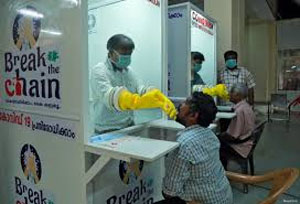
god-rahul                     Source:VOANEWS

On 16th of march, Kerala launched “Break the chain” campaign to combat Covid-19 at its primitive stage. The main aim of the campaign was to educate people about importance of hygiene. This campaign to limit the spread of corona virus was undeniably successful. After certain amount of spread the district authorities prepared route maps of the infected people specifying the places they travelled after the initial symptoms were noticed. Kerala is quarantining people for 28 days instead of 14 days, as recommended by the center. The patients in quarantine were blessed enough to have choice of meals, wi-fi services and counselling. The anti-Covid task force led by renowned doctors and administrators used a hotline to provide stress relief to affected people.

At a point of time the state faced a shortage in supply of hand sanitizers due to excessive demand during the initial days and due to hoarding of the product. A Public-Sector Undertaking named Kerala State Drugs and Pharmaceuticals ltd assured the government that it would produce enough sanitizers for the state at a minimal rate of 125/- for a 500 ml bottle.

One of the most disgusting factor recognized during this lockdown period is spreading of rumors and fake news, it not only initiates unnecessary rivalries but it also affects out mental health. The government of Kerala not only asked the police to take strict actions against people who are behind the menace, but also launched its app GOK Direct.

The states multilayered combating policies including healthcare (not only physical but also mental), proper communication system and stringent policies helped it to set an example in front of the whole world during this time of global distress. The instance showed us the importance of government and public cooperation and over and above, the importance of well nurtured human capital. The war is not yet over but Kerala is very well prepared to defeat COVID-19.

- RAHUL SINHA FOR ECOBUZZ

Mail Id: srahul.27501@gmail.com

Monday, May 18, 2020

Fall in female LFPR and Gender pay gaps in India

Fall in Female LFPR and Gender Pay Gaps in India

There is growing literature about the  paradox between female literacy and female employment where female literacy is increasing but female labour force participation is decreasing . 

Labour force participation rate, or LFPR is the measure of proportion of a country’s working age population (who belong to the age group from 15 to 64 years) who are either working or actively looking for work.  The formula for calculating LFPR is labour force, that is, employed persons and unemployed persons who are actively looking for jobs divided by the total working-age population. 
LFPR(%) =  x 100
Source: World Bank 2017

In the case of India, it has been observed that the female LFPR increased in the early 2000s, followed by a rapid fall from 31.942% in 2000 to 25.012% in 2017 according to the modeled ILO (International Labour Organisation) estimate. 
Source: World Bank 2017

The female LFPR is a U-shaped curve. It suggests that the female LFPR falls in the early stages of economic growth and then eventually rises in the later stages. 

Education as a Factor

Male education is a factor for low female LFPR as their education is assumed to be a proxy for household income.. When men’s education rises, it is expected that men would be employed which would bring in sufficient wealth into the household. This factor thus results in women having an option of whether they wish to be a part of the labour force or not. It has been seen that as  household wealth increases,  female LFPR falls. Women having basic education have a higher probability of not exiting employment as compared to women having a secondary level of education. It is so because in the Indian job sector, especially in the service sector, women with secondary level of education do not have the required expertise to work under such circumstances. Discrimination through wages is also very prevalant. On the other hand, women having primary education generally enter into the labour intensive market such as manufacturing sector which in return helps the women to retain their jobs and therefore the LFPR does not reduce. 

Women who remain unemployed generally increase their education level andWomen having secondary education usually have higher levels of human capital and skills which should yield higher incomes. In India however, it is the opposite. Many educated Indian women are placed on the lower end of the U-shaped curve which can be drawn out when education and female LFPR is plotted.
Other factors such as higher enrollment of women in higher education and lack of jobs also lead to a fall in female LFPR. It has been examined by a study (Chatterjee et al, 2018) that there is a J-shaped relationship between female LFPR and education in India which states that as the secondary education increases, the female LFPR falls. This should not be the case. 

Social,  Cultural and Financial  Factors
In India, social customs and the caste system do not focus on ‘empowering’ women. It is generally assumed that domestic work has to be done by them. Women, in the disadvantaged classes, that is, Schedule Tribes(STs), Schedule Castes(SCs) and Other Backward Classes(OBCs) are observed to have greater employment in comparison to high caste women in rural areas. 

Another observation has been that women who belong to higher castes get multiple choices with reference to work whereas such choices do not exist for women of the marginalised sections of society.Women in rural areas tend to have higher probabilities of exiting from employment and lower probabilities of entering into employment if they belong to a wealthier household. 

Social norms also restrain women’s mobility and reduce female LFPR. 
For example, the presence of in-laws reduces the probability of exiting from employment. At same time, if there are quite a few elderly family members, it leads to an increase in the probability of women exiting employment, because the in-laws help in taking care of the children and therefore, women can go out of the house for work. but if there are elderly family members the female member of the family needs to take care of them too and hence cannot join the labour force. 

Economic Factors

The reduction of the female LFPR is also because of the transition of the Indian economy from an agrarian economy towards a service oriented economy. This transition ignored the creation of jobs in the manufacturing sector and in turn caused a shortage of jobs for the mid level educated women in the Indian economy. 


Gender Pay Gap

Another factor which contributes to low female LFPR is discrimination of gender on the basis of wages. There exists a huge gap in wages between the male and female workers. The wage gap is about 30 percent higher in rural areas and 24.3 percent higher in urban areas. There is a substantial difference of wages among workers, both male and female, in different regions, sectors and genders. The women in rural formal sector earn less than the males in the urban informal sector and women who are in the urban formal sector earn less than men in the rural informal sector according to the NSSO data. It has also been observed that the market faces a lot of imperfections which prevents the female from entering the labor market. The vocational skills imparted to women have not considerably made any changes in the LFPR making it low. On the other hand, males with similar skills are called in for jobs in the labor market.. 

Women also face wage discrimination in the traditional activities of the tertiary sector.It has been observed that due to low skill formation in women (as compared to men) there is such discrimination of wages. 


Policies and Recommendations

Studies have suggested and recommended policies which would help narrow the gap between such wage gaps and promote higher LFPR.  

Implemented Policies

The National Rural Employment Guarantee Act (NREGA) is an initiative by the government to boost female LFPR.  It was enacted in 2005 and guarantees 100 days of work per year. The initiative has had a major impact on the rural sector increasing both private and public employment.  

A new Ministry of Skill Development and Entrepreneurship has been established to organise and establish skill development schemes across different sectors and states in India. In order to increase the LFPR, the government has taken initiatives such as The Micro-enterprise Development Programme by NABARD to train women through Women Industrial Training Institutes, National Vocational Training Institutes and Regional Vocational Training Institutes. 

Legal Initiatives:

The Equal Remuneration Act, 1976 provides the basis to maintain equality between the wages earned by male and female workers. The Minimum Wage Act also helps  maintain a basic wage for the male and female workers without any discrimination. According to the legislature, both the Companies Act, 2013 and Factories Act 1948 have provisions which promote equality of females in the workplace. 

Policies Recommended to boost female LFPR

Rigid labour regulations would lead to a lower LFPR. It is important to make the regulations flexible at certain points which benefits the economy and enhances the female LFPR. The employment of women is restricted to only a few industries. Therefore, policies should be drafted in such a way which helps in increasing access of women into different sectors. This can be done by investing in diversified sectors and upgrading to high-end activities. 
Policies should also be implemented to develop infrastructural facilities like transport, housing, sanitisation facilities and so on. Security and flexible work hours for pregnant women should be available. 

The Self Help Groups or SHGs should formulate policies which benefit the members by having access to finance, market and enhancing employment. Such SHGs have the ability to influence laws at state and district level. These groups need to be organised vertically and horizontally according to their organisation structure to strengthen the rural population. Agriculture, which is still the largest employer of female labour, can be utilized as a source of economic growth and job creation if women are ensured ownership rights and control over lands, shift to high value-added crops, supported by other policy measures. 

Policies Recommended for Reducing Gender Wage Gap In India: 

To measure and control the disparity in the gender gap of male and female, the government should implement a robust and continuously mentoring wage level system in both the urban and rural areas. It should also strengthen the compliance towards equality and make gender pay gaps or GPG a punishable offence.  At the organisational level, the recruiters and selectors should make sure that the compensation and incentives, both financial and non-financial, are properly allocated towards both male and female employees without discrimation. Mechanisms should be transparent and robust in implementing and maintaining a threshold in order to minimise the GPG as much as possible. The Human Resource Manager should take into consideration few policies such as equality in promotion, bonus and other incentives in order to reduce gender inequality. At an academic level, vocational programs should be organised in order to sponsor women’s education and skill development with an unbiased approach.  

References
Sarkar, S., Sahoo, S., & Klasen, S. (2019). Employment transitions of women in India: A panel analysis. World Development, 115, 291-309.
Afridi, F., Dinkelman, T., & Mahajan, K. (2018). Why are fewer married women joining the workforce in rural India? A decomposition analysis over two decades. Journal of Population Economics, 31(3), 783-818.
Goldin, C. (1994). The U-shaped female labor force function in economic development and economic history (No. w4707). National Bureau of Economic Research.
Chatterjee, E., Desai, S., & Vanneman, R. (2018). INDIAN PARADOX: RISING EDUCATION, DECLINING WOMENS’ EMPLOYMENT. Demographic research, 38, 

Reverse Migration

"Epidemics are not random events that can afflict societies capriciously and without warning"   says historian Frank S...