Monday, May 25, 2020

How HAM can be an effective tool for growth of the Indian Economy?


Abstract 

This article focuses on the concept of the Hybrid Annuity Model which comprises of two existing models. It gives light on how this model can be a tool for economic growth and development of the Indian Economy. It highlights the advancements and needs for implementing such a model for the benefits of the government, developers and investors. It also speaks about the reasons behind implementing such a model. 

Keyword(s): Hybrid Annuity Model, economic growth, Indian Economy;

Introduction

Transport minister Nitin Gadkari actively promoted his brain-child — the Hybrid-Annuity Model or HAM. Introduced in January 2016 to revive investments in road infrastructure projects, HAM has seen good initial success. About 30 highways projects have been awarded under HAM by the National Highway Authority of India (NHAI) at a total cost of about ₹28,000 crore. Half the projects awarded in 2016-17 were under HAM

Literature Review

The concept of Hybrid Annuity Model (HAM) was brought in to rejuvenate the Public Private Partnerships in highway construction. HAM is a model that is consisting of two more existing models, that is, BOT Annuity and EPC. To understand the concept of HAM, we need to understand these two models. 

1. BOT or The Build Operate and Transfer Annuity Model
Under such kind of model, the developer builds and operates the highway for a certain period of time and returns it to the government. When this asset is used for commercial purpose, the government pays the developer a considerable amount. 

2. BOT Toll Model
Under this model, the developer is allowed to recover his investment through the tolls collected from the highway. 

3. Engineering, Procurement and Construction Model
Under this model, all the costs relating to engineering, procurement of raw materials and the construction is borne by the government itself. A huge financial burden is imposed on the government. 
In financial terminology, hybrid annuity refers to those payments that are made in fixed instalment up to a certain time period and becomes variable henceforth for the remaining period. Such a payment method is followed under HAM.  As per the model, the government contributes about 40% of the project costs in the first five years of the project. The rest 60% will be paid in variable amounts as per the value of the asset after construction. The developers, in return, invest about 25 percent as equity and raise the balance as debt. Under HAM, the revenue collection is done by National Highway Authority of India (NHAI). 

This model is expected to lower the initial capital outflow for the government, as bulk of the payment will be done through annuity payments. Further, the private entity will be insulated from traffic and inflation risks, as these will be looked after by the government.

 
Reasons for implementation of HAM

1. It would help in improving the financial mechanism in the road development sector. 

2. Return of the old contractors
Leading developers, including Larsen and Toubro Ltd, IL&FS Transportation Networks Ltd (ITNL), GVK Power and Infrastructure Ltd, GMR Infrastructure Ltd, IVRCL Ltd, Gammon Infrastructure Projects Ltd and Hindustan Construction Co. (HCC) Ltd, were no longer actively participating in road construction bids as their balance sheets are stressed. To bring back such developers back into the market the model was implemented as the cost is shared between the developer and the government. 

3. No aggressive bidding
 In spite of the lower equity investment requirement and the minimal revenue risks in this model, many existing companies with hugely stressed balance sheets may still struggle to participate in these bids because any incremental equity outlay and project finance may be beyond their present means. It will also see new and small companies bidding for highway projects instead of focusing on EPC opportunities.

4. Stress-free lending
Lending for hybrid annuity-modelled projects would be comparatively easier as there is no traffic risk associated. Lenders would be comfortable as the execution risk is less for contractors as the bidding rolls out only after 90% land is available

Development of HAM
The visibility of high visibility of projects are to be implemented over five years, worth around Rs5.35 lakh crore for 35000km. The bid project cost remains at around Rs23-35 crores. Further, the L1 (lowest) bids are on average 15 per cent higher than NHAI’s estimated EPC costs, though the difference between L1 and L2 bidders has doubled to 8 per cent last fiscal from 4 per cent in FY17. 

  
HAM has become the preferred contract for the NHAI, rising from less than 10 per cent of awards in FY16 to nearly 50 per cent in FY18. The represents an order award value growth from ₹7,000 crore to ₹76,500 crore in just three years.  the Ministry of Road and Transport (MoRTH) awarded projects of around 17,000 km, of which 7,397 km was awarded by NHAI.
 
How it is an effective tool for the growth of Indian Economy?
HAM facilitates capital inflows. This means that the economy would increase in its productive capacity without having much inflation from this sector. It also helps to give more liquidity in the market. Liquidity in such an illiquid market is very important for the economy. This gives the developers confidence on the market and they are eager to contribute to such projects. As the cost burden is divided between the government and the developer, the entire burden does not fall on the government which helps them to save revenue and they can use it in productive purposes which would be beneficial for the general public. The government has to bear the financial risk partly which does not become a burden on the economy as a whole. It propagates foreign or international contractors to contribute to such projects which eventually is beneficial for the economy. HAM was introduced to help the well-placed construction companies with lower debit and better financials to secure their order books. The idea was to bring in responsible and seasoned players that would be accountable enough to secure and execute projects. This also helps investors to invest in such projects in the long run. This induces FDI which is quite beneficial for the economy as well. It will facilitate uplifting the socio-economic condition of the entire nation due to increased connectivity across the length and breadth of the country leading to enhanced economic activity.

- NANDINI SIL 
FOR ECOBUZZ

Sunday, May 24, 2020

The Poor Children in the Corona Mayhem


             Image source : BBC news


The novel Coronovirus has sent the world into a chaos. It is so unprecedented that many of us still are wondering, while sitting at home, whether this is a dream or not. Is this is just a bad dream and we will wake up to a “normal day” tomorrow and live our “normal lives” again? Sadly, the deadly virus sets a new precedent and we are having a “new normal” accosting all of us. With widespread containment measures, stalling all economic and social activities, the world will never be the same, at least for the foreseeable future. While this is being addressed as nature’s way of damage repair and reclaiming itself from the prolonged tortures of human beings, the fallouts that the economies and human lives will face will definitely not be pleasant. It is a privilege to be at home and research on the Covid-19 issues while many of the world’s population are facing the worst times of their lives. Specially the children; the poverty struck children.
Whilst the coronavirus has so far reported less severe cases among children, it can decimate their lives in a different way. The ‘physical distancing’ measures increasingly result in parents not being able to work, as usual businesses are rapidly grinding to a halt across the world.  Meanwhile traditional care providers – schools and nurseries – have had to close. Even as the spread of the virus slows in some countries, its social toll will come fast and hard. And in many places, it will come at the expense of the most vulnerable children.  Such children are in millions, living in vulnerable communities in countries all around the world apprehending the sufferings from the far reaching economic and social impacts of the measures needed to contain the pandemic. 
 At the forefront are millions of girls and boys including those who have been uprooted by conflict, children living with disabilities and girls at risk of violence. Keeping in mind this population group, this health crisis risks becoming a child-rights crisis. Many children around the world, including those displaced by conflict, live in camps, informal settlements and on the streets. For them maintaining social distancing norms and complying with basic hygiene like washing hands is very difficult. Again, homes are not always a safe haven, particularly in times of financial stress. When families that are already dependent on casual, informal jobs, are laid off or are forced to isolate because of the COVID-19 outbreak, they have little to fall back on.  They have more debts than savings, and cannot afford to stockpile food and other necessities. A break in income can have devastating consequences. For families in poverty, missing work implies missing meals, making it hard to comply with government and health advice. These parents helplessly can’t set a good example for children who are looking up to them and can’t support them either. Many schools in poor countries are subsidized by the government to offer free meals during the school hours but with closing of schools, such options are not available now either. For children living with domestic abuse and gender-based violence, staying home can be a risk in itself.
The United Nations Children’s Emergency Fund (UNICEF) has chalked out a multipronged plan to help these vulnerable children in this crisis. It calls on governments and partners to sustain life-saving maternal, newborn and child health services. This means continuing to meet the urgent needs posed by COVID-19, while carrying forward critical health interventions, like funding for vaccinations, that ensure children survive and thrive. Hospitals should have provisions for treatment of other health issues -diseases like pneumonia, malaria and diarrhea- so that infants and children will not lose their lives to preventable causes.
Some children are cut off from safe water because they live in remote areas, or in places where water is untreated or polluted, like those living in slums or streets. With maintenance of good hygiene practices more important than ever, more girls and boys should be reached out to, with clean water and basic hygiene facilities. UNICEF calls upon governments to prioritize these universal sanitization measures.
As educators have come up with unconventional ways to keep the teaching-learning process going amidst the crisis, many children across the world do not have access to books or school supplies, let alone the internet. Governments have to scale up home learning options, pursuing no-tech and low-tech solutions to bridge the digital-gap, and prioritize internet connectivity in remote and rural areas. With more than 800 million children out of school, now is the time to direct national funding for education and not lag behind on constructing a brighter future for all of us.
As millions of parents struggle to maintain their livelihoods and income, tens of millions of children already living on the edge of hardship will fall into poverty, unless urgent steps are taken to combat the socio-economic impacts of this outbreak. Government must adopt security measures to protect jobs and to adequately support working parents. Instead of making direct cash transfers, there should be a provision for “conditional cash transfers” to make sure the money is spent for the intended purpose and not diverted into other areas of self-interest by the poor people, along with support for food and nutrition. The government really has to work credibly and transparently in these respects for the sake of overall welfare.
As already mentioned, while this “stay at home” policy is for the benefit of people at large, we have many little Samaritans who are putting their own lives at stake to not flout this protocol- the children who are subject to domestic violence and exploitation. They would rather be anywhere else but at home, right? Governments need to account for the unique risks of girls and vulnerable children, including those who face discrimination and stigma, when planning for social distancing and other COVID-19 response measures.
On a usual basis, refugee and migrant children and those affected by conflict, face unspeakable threats to their safety and well-being – and this in the absence of a pandemic. Access to basic health care facilities is undoubtedly very limited for them and their bare survival in cramped living conditions highlights the infeasibility of social distancing. It goes without saying that health systems in war-ravaged countries are already on the brink of collapse.  The United Nations Secretary-General has called for a global ceasefire to focus our fight on a common enemy, instead of against each other. It is up to the global community to prioritize humanitarian needs during this pandemic above all else, to come together in support of these children separated from their families and homes and uphold their rights and protect them from this virus.
We can’t paint a fine picture of the future barring the children of today, and expect it to come true.  They are the forerunners and makers of the future. For that, they need to be taken care of, protected, nurtured and educated. It is important to mention Greta Thunberg, the Swedish environmental activist who has received international acclamation for protesting against climate change, has started a fundraiser with Danish NGO Human Act to support UNICEF’s work to protect children’s lives during the Corona pandemic. The 17 year old says “We must now all act together to protect children and end the devastating consequences of the coronavirus. Children are the future and they must be protected.”  Thunberg is known for her youth and her straightforward speaking manner, both in public and to political leaders and assemblies. Despite having nemeses, she has fans among all age groups with many children admiring her as a role model. Keeping aside controversial opinions, she is a good example of a human for the future and we can have several others like her if proper plans are crafted and executed now. Crises and pandemics wreak havoc globally; the children should not be the worst sufferers.

- AARSHIYA BASU
MA ECONOMICS, 2ND SEMESTER
ST. XAVIER’S UNIVERSITY, KOLKATA

Wednesday, May 20, 2020

Why Couldn't COVID-19 prevail over God's own country?


Our goals can only be reached through a vehicle of a plan, in which we must fervently believe and upon which we must vigorously act. There is no other route to success. 

                    – Pablo Picasso


From motivating the public through press conferences to imposing restrictions and resisting the shocks, Kerala’s efforts are praiseworthy. Kerala invested a lot for its human capital over a long period of time, the literacy rate touches the sky the healthcare facilities are significant. Kerala’s political history states its in-depth linkage with communism. But when it comes development and welfare the ideologies are compromised. Kerala’s healthcare system is highly privatized with healthy division of labour between private and public sectors. Kerala even managed to cope up after the floods in 2018 due to its decentralized and effective system. Kerala also has one of the highest doctor-patient ratios in the country. The doctor-patient ratio in the state, which nearly stands at 1:400, which is much higher than the World Health Organization recommended 1:1000.

Kerala also took lessons from its last experience dealing with the Nipah virus, which neither had treatment nor proper vaccine. The state recognized certain protocols like isolation, contact tracing and alert community surveillance system, which they also implemented during their war against the Corona Virus.

Even before nation wide lockdown, Kerala implemented various actions like shutting down schools and banning public gatherings. The mid-day meals were delivered to the children at their homes, this effort was admirable and was cherished by various eminent personalities.

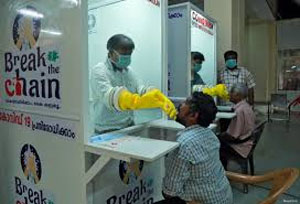
god-rahul                     Source:VOANEWS

On 16th of march, Kerala launched “Break the chain” campaign to combat Covid-19 at its primitive stage. The main aim of the campaign was to educate people about importance of hygiene. This campaign to limit the spread of corona virus was undeniably successful. After certain amount of spread the district authorities prepared route maps of the infected people specifying the places they travelled after the initial symptoms were noticed. Kerala is quarantining people for 28 days instead of 14 days, as recommended by the center. The patients in quarantine were blessed enough to have choice of meals, wi-fi services and counselling. The anti-Covid task force led by renowned doctors and administrators used a hotline to provide stress relief to affected people.

At a point of time the state faced a shortage in supply of hand sanitizers due to excessive demand during the initial days and due to hoarding of the product. A Public-Sector Undertaking named Kerala State Drugs and Pharmaceuticals ltd assured the government that it would produce enough sanitizers for the state at a minimal rate of 125/- for a 500 ml bottle.

One of the most disgusting factor recognized during this lockdown period is spreading of rumors and fake news, it not only initiates unnecessary rivalries but it also affects out mental health. The government of Kerala not only asked the police to take strict actions against people who are behind the menace, but also launched its app GOK Direct.

The states multilayered combating policies including healthcare (not only physical but also mental), proper communication system and stringent policies helped it to set an example in front of the whole world during this time of global distress. The instance showed us the importance of government and public cooperation and over and above, the importance of well nurtured human capital. The war is not yet over but Kerala is very well prepared to defeat COVID-19.

- RAHUL SINHA FOR ECOBUZZ

Mail Id: srahul.27501@gmail.com

Monday, May 18, 2020

Fall in female LFPR and Gender pay gaps in India

Fall in Female LFPR and Gender Pay Gaps in India

There is growing literature about the  paradox between female literacy and female employment where female literacy is increasing but female labour force participation is decreasing . 

Labour force participation rate, or LFPR is the measure of proportion of a country’s working age population (who belong to the age group from 15 to 64 years) who are either working or actively looking for work.  The formula for calculating LFPR is labour force, that is, employed persons and unemployed persons who are actively looking for jobs divided by the total working-age population. 
LFPR(%) =  x 100
Source: World Bank 2017

In the case of India, it has been observed that the female LFPR increased in the early 2000s, followed by a rapid fall from 31.942% in 2000 to 25.012% in 2017 according to the modeled ILO (International Labour Organisation) estimate. 
Source: World Bank 2017

The female LFPR is a U-shaped curve. It suggests that the female LFPR falls in the early stages of economic growth and then eventually rises in the later stages. 

Education as a Factor

Male education is a factor for low female LFPR as their education is assumed to be a proxy for household income.. When men’s education rises, it is expected that men would be employed which would bring in sufficient wealth into the household. This factor thus results in women having an option of whether they wish to be a part of the labour force or not. It has been seen that as  household wealth increases,  female LFPR falls. Women having basic education have a higher probability of not exiting employment as compared to women having a secondary level of education. It is so because in the Indian job sector, especially in the service sector, women with secondary level of education do not have the required expertise to work under such circumstances. Discrimination through wages is also very prevalant. On the other hand, women having primary education generally enter into the labour intensive market such as manufacturing sector which in return helps the women to retain their jobs and therefore the LFPR does not reduce. 

Women who remain unemployed generally increase their education level andWomen having secondary education usually have higher levels of human capital and skills which should yield higher incomes. In India however, it is the opposite. Many educated Indian women are placed on the lower end of the U-shaped curve which can be drawn out when education and female LFPR is plotted.
Other factors such as higher enrollment of women in higher education and lack of jobs also lead to a fall in female LFPR. It has been examined by a study (Chatterjee et al, 2018) that there is a J-shaped relationship between female LFPR and education in India which states that as the secondary education increases, the female LFPR falls. This should not be the case. 

Social,  Cultural and Financial  Factors
In India, social customs and the caste system do not focus on ‘empowering’ women. It is generally assumed that domestic work has to be done by them. Women, in the disadvantaged classes, that is, Schedule Tribes(STs), Schedule Castes(SCs) and Other Backward Classes(OBCs) are observed to have greater employment in comparison to high caste women in rural areas. 

Another observation has been that women who belong to higher castes get multiple choices with reference to work whereas such choices do not exist for women of the marginalised sections of society.Women in rural areas tend to have higher probabilities of exiting from employment and lower probabilities of entering into employment if they belong to a wealthier household. 

Social norms also restrain women’s mobility and reduce female LFPR. 
For example, the presence of in-laws reduces the probability of exiting from employment. At same time, if there are quite a few elderly family members, it leads to an increase in the probability of women exiting employment, because the in-laws help in taking care of the children and therefore, women can go out of the house for work. but if there are elderly family members the female member of the family needs to take care of them too and hence cannot join the labour force. 

Economic Factors

The reduction of the female LFPR is also because of the transition of the Indian economy from an agrarian economy towards a service oriented economy. This transition ignored the creation of jobs in the manufacturing sector and in turn caused a shortage of jobs for the mid level educated women in the Indian economy. 


Gender Pay Gap

Another factor which contributes to low female LFPR is discrimination of gender on the basis of wages. There exists a huge gap in wages between the male and female workers. The wage gap is about 30 percent higher in rural areas and 24.3 percent higher in urban areas. There is a substantial difference of wages among workers, both male and female, in different regions, sectors and genders. The women in rural formal sector earn less than the males in the urban informal sector and women who are in the urban formal sector earn less than men in the rural informal sector according to the NSSO data. It has also been observed that the market faces a lot of imperfections which prevents the female from entering the labor market. The vocational skills imparted to women have not considerably made any changes in the LFPR making it low. On the other hand, males with similar skills are called in for jobs in the labor market.. 

Women also face wage discrimination in the traditional activities of the tertiary sector.It has been observed that due to low skill formation in women (as compared to men) there is such discrimination of wages. 


Policies and Recommendations

Studies have suggested and recommended policies which would help narrow the gap between such wage gaps and promote higher LFPR.  

Implemented Policies

The National Rural Employment Guarantee Act (NREGA) is an initiative by the government to boost female LFPR.  It was enacted in 2005 and guarantees 100 days of work per year. The initiative has had a major impact on the rural sector increasing both private and public employment.  

A new Ministry of Skill Development and Entrepreneurship has been established to organise and establish skill development schemes across different sectors and states in India. In order to increase the LFPR, the government has taken initiatives such as The Micro-enterprise Development Programme by NABARD to train women through Women Industrial Training Institutes, National Vocational Training Institutes and Regional Vocational Training Institutes. 

Legal Initiatives:

The Equal Remuneration Act, 1976 provides the basis to maintain equality between the wages earned by male and female workers. The Minimum Wage Act also helps  maintain a basic wage for the male and female workers without any discrimination. According to the legislature, both the Companies Act, 2013 and Factories Act 1948 have provisions which promote equality of females in the workplace. 

Policies Recommended to boost female LFPR

Rigid labour regulations would lead to a lower LFPR. It is important to make the regulations flexible at certain points which benefits the economy and enhances the female LFPR. The employment of women is restricted to only a few industries. Therefore, policies should be drafted in such a way which helps in increasing access of women into different sectors. This can be done by investing in diversified sectors and upgrading to high-end activities. 
Policies should also be implemented to develop infrastructural facilities like transport, housing, sanitisation facilities and so on. Security and flexible work hours for pregnant women should be available. 

The Self Help Groups or SHGs should formulate policies which benefit the members by having access to finance, market and enhancing employment. Such SHGs have the ability to influence laws at state and district level. These groups need to be organised vertically and horizontally according to their organisation structure to strengthen the rural population. Agriculture, which is still the largest employer of female labour, can be utilized as a source of economic growth and job creation if women are ensured ownership rights and control over lands, shift to high value-added crops, supported by other policy measures. 

Policies Recommended for Reducing Gender Wage Gap In India: 

To measure and control the disparity in the gender gap of male and female, the government should implement a robust and continuously mentoring wage level system in both the urban and rural areas. It should also strengthen the compliance towards equality and make gender pay gaps or GPG a punishable offence.  At the organisational level, the recruiters and selectors should make sure that the compensation and incentives, both financial and non-financial, are properly allocated towards both male and female employees without discrimation. Mechanisms should be transparent and robust in implementing and maintaining a threshold in order to minimise the GPG as much as possible. The Human Resource Manager should take into consideration few policies such as equality in promotion, bonus and other incentives in order to reduce gender inequality. At an academic level, vocational programs should be organised in order to sponsor women’s education and skill development with an unbiased approach.  

References
Sarkar, S., Sahoo, S., & Klasen, S. (2019). Employment transitions of women in India: A panel analysis. World Development, 115, 291-309.
Afridi, F., Dinkelman, T., & Mahajan, K. (2018). Why are fewer married women joining the workforce in rural India? A decomposition analysis over two decades. Journal of Population Economics, 31(3), 783-818.
Goldin, C. (1994). The U-shaped female labor force function in economic development and economic history (No. w4707). National Bureau of Economic Research.
Chatterjee, E., Desai, S., & Vanneman, R. (2018). INDIAN PARADOX: RISING EDUCATION, DECLINING WOMENS’ EMPLOYMENT. Demographic research, 38, 

Saturday, May 16, 2020

Is there a bright side of rural sector post lockdown?

Is there a bright side of rural sector post lockdown? 
-Sweta Shaw 

Yes, that’s true. Government & individual behaviours have changed to cope with COVID-19, and economic behaviour will change too. Agriculture & rural industry could be India’s strength.


source - giving compass


Farmers put wheat crop through a crusher in Uttar Pradesh

As India eases the lockdown, there is fear that nothing has been gained in the past few painful weeks rather months, and the novel coronavirus will started spreading again. Looking at liquor queues in urban India, it may be tempting to think so, but the fears may be overblown at the scale of the economy as a whole.
The behaviour of governments, individuals and businesses will reshape the Indian economy, and safer activities and locations will flourish more. If supported by the right policy framework, agriculture and rural industry could be one of India’s biggest strengths.
Epidemiological models predicted a larger number of cases and deaths across many countries than actually observed. In the absence of a vaccine, what explains this? Economists explain the phenomenon by changes in behaviour — of both governments and people — which fits the old intuition in economic analysis that agents respond to incentives.
John Cochrane, for example, presents a behavioural ‘SIR model’, in which the rate at which people transition from ‘Susceptible’ to ‘Infectious’ to ‘Recovered’ is shaped by their behaviour.
Amid the coronavirus lockdown across the country that brought economic activity to a near halt, the Modi government is expecting that agriculture sector could be a silver lining for the Indian economy as it is estimated to grow at a rate of 3 per cent for the year 2020-21, according to NITI Aayog.
NITI Aayog member Ramesh Chand said at a press conference Wednesday that currently the growth of the agriculture sector is 60 per cent more than the non-agriculture sectors, which is very rare.
NITI Aayog attributed the estimated growth in the agricultural sector to normal monsoon this year along with India’s water availability in reservoirs, which is 40-60 per cent higher than last year, said Chand.
Union Agriculture Minister Narendra Singh Tomar, who was also present at the press conference, said: “The growth rate in real terms for the agriculture sector in 2019-20 was 3.7 per cent which can be deduced at 11.3 per cent in current prices.” 
According to the Economic Survey 2019-20, the annual growth rate in real terms in agriculture and its allied sectors was 2.88 per cent from 2014-15 to 2018-19 whereas the estimated growth rate in 2019-20 was 2.9 per cent.
Chand said almost 60 per cent of the economy is still not functioning as of now.  
“Share of agriculture sector in Indian economy is 17 per cent, which is higher than the manufacturing sector, and agriculture alone will give more than 0.52 per cent to the growth rate of Indian economy as markets are intact and prices have not crashed,” he added.
Chand also said sale of fertilizer in April this year is higher than the same period last year — with an increase to 13.5 lakh tonnes from 12.86 lakh tonnes in 2019.
Measures for farmers
Mentioning about the steps taken by the government to help farmers during the lockdown, minister Tomar listed the exemptions announced for the agriculture sector and highlighted government platforms such as e-NAM, Kisan Rath app and the All India Agri Transport Call Centre launched for their benefit.
e-Nam is an online trading platform for agricultural commodities, while Kisan Rath app facilitates transportation of agri-produce across the country. The All India Agri Transport Call Centre was launched to facilitate inter-state movement of perishables during the lockdown.
“The Pradhan Mantri Kisan Samman Nidhi (PM-KISAN) scheme has benefited farmers as Rs 17,986 crore has been disbursed since 24 March,” the minister added.
Tomar, meanwhile, said there was no shortage of food grains, milk or vegetables during the lockdown.
India has set a food grain production target of 298.3 million tonnes for 2020-21 fiscal year against 291.95 million tonnes in 2019-20 and 285.20 million tonnes in 2018-19.

Tuesday, May 5, 2020

A brief idea about Human Development Index and Analysis of India's HDI 2019

Human Development is an approach that is focused on creating fair opportunities and choices for all people. Human Development revolves around three basic foundations, that is, to live a healthy and productive life, to be knowledgeable and to have access to resources needed for a decent standard of living. The better the working conditions and equality among the employees, the better is the productivity. .
The Human Development Index (HDI) is a statistical tool used to measure a country's overall achievement in its social and economic dimensions. These dimensions can be based on the health of people, their level of education attainment and their standard of living. The concept of human development was introduced by Mahbubul Haq. Sen (1989) has greatly influenced international organizations such as the United National Development Programme (UNDP), International Labour Organization (ILO) and the World Bank. Over the years, he introduced innovative solutions to help underdeveloped countries cope with social problems like poverty, famine, gender inequality, human rights and biased liberalism.  The formula for calculating the  Human Development Index  is  given by:
HDI = 1/3(Life expectancy Index) + 1/3(Education Index /Literacy Index) + 1/3(  Gross National Income Per Capita Index)

The HDI data is regularly published by the United Nations Development Programme. It is about providing people with opportunities. The process of development – human development - should at least create an environment for people, individually and collectively, to develop to their full potential and to have a reasonable chance of leading productive and creative lives that they value.
The differences across the world in terms of HDI is very large. Starting from the highest values in North America, Europe, Japan, and Oceania to the lowest in central Africa. Now speaking about India and analyzing the 2019 report published by the UNDP, we notice-
According to the 2019 Human Development Report India’s rank rose by one position, that is, it is at 129th out of the 189 countries. Inequality and deprivation continue to be high in the country. India’s HDI for 2018 improved to 0.647 compared to 0.640 the year before. It was reported that despite lifting up around 271 million people out of poverty between 2005-2015, India still owns around 28% of the world’s poor and needy.
 The annual report on HDI ranks India at the 129th position which is a slight improvement from the previous year. However, India remains the home of 364 million poor people (28 percent), out of a global population of the 1.3 billion. Around 661 million of these poor people live in Asia and the Pacific.
 Between 1990 and 2018, India’s HDI value has risen by 50 per cent (from 0.431 to 0.647), which places it above the average for countries in the medium human development group (0.634). We are very well addressed to the fact that HDI components have equal contribution is raising the Human Development Index. In other words, an increase in all the 3 components will lead to a rise the HDI value of a country. Therefore, after glancing through the reports it was noticed that the life expectancy at birth in India increased by 11.6 years, whereas the average number of schooling years increased by 3.5 years. Per capita incomes increased 250 times. Despite all these efforts India still remains in the medium HDI group, while countries like US, China and Singapore fall into the high HDI group. 
 It is very clear that there are several other areas which need proper attention. It has been noticed that group-based inequalities persist especially affecting women and girls. The report states that as the number of people coming out of poverty is increasing, the world is veering towards another type of poverty based on technology, education and climate, according to the report. India has both types of poverty.  Some Indians do not have proper access to healthcare and education while some are becoming poor based on the new criteria.

India’s development initiatives like the Pradhan Mantri Jan Dhan Yojana  focusing on financial inclusion and Ayushman  Bharat  focusing on universal health care are crucial in ensuring that we meet the needs and  fulfill the Prime Minister’s vision of development for all.
The current levels of human development in India are extremely low for many reasons such as finance, education, gender inequality and many more. These have caused many concerning effects on India’s society. In terms of causes that affected human development in India as a whole, there aren’t many, but they affect India at very high levels.

One includes the presences of the caste system in India. The separation and classification of various Indian societies by socio-economic status has resulted in many becoming disadvantaged, and having low levels of education, health and income within their society As a result, individuals  suffer greatly due to this and ultimately the reducing the human development index as a whole.

Another cause of low levels of human development includes the lack of socioeconomic safety nets. One of the major reasons why India still lags behind is because it does not have ‘socioeconomic safety nets’ for the urban poor. Socioeconomic safety nets are transfer programs with the aim of preventing the poor from falling below a certain poverty level. India does not have these transfer programs and as a result many people are subjected to very extreme levels of poverty. Basic needs are missing among these people, and they live extremely difficult lives.

How we tackle these problems, ranging from access to basic services such as housing to things like access to quality university education, will ensure the ability of the entire nation to achieve the Development Goals. Focus on education, nutrition and health, and service skills can help in expanding human capital and provide for constant progress which in turn will improve HDI. We know that Human Development is an index indicating the development of the country. Hence, it is now the duty of the government to step in and take all the necessary actions so as to raise India’s human development and make India at par with the other developing and developed nations.
 Unfortunately, the year 2020 has been a huge shock to the Indian economy. The scale of the economic damage caused by the Covid-19 pandemic will be far greater than that caused by the 2008 global financial crisis, globally as well as for India.
While, dealing with the after-effects of Covid-19 will be a major challenge for the next few years. Hence, the government has to bring effective as well as appropriate strategies to help India fight this battle.

- Komal Wahi for Ecobuzz

Reverse Migration

"Epidemics are not random events that can afflict societies capriciously and without warning"   says historian Frank S...